Showing posts with label Hector Guimard. Show all posts

Tuesday, March 14, 2017

La Tour d'Argent - les lumières


La Tour d'Argent


Although I have not dined at La Tour d'Argent 
and would love to explore their wine list
one can enjoy the aesthetics of the wrought iron lamp posts
and the Guimard awning over the entrance door.


La Tour d'Argent
15, quai de la Tournelle
75005, Paris


Thursday, January 14, 2016

Hôtel Récamier


Hôtel Récamier


Wonderfully situated in a corner of Place Saint-Sulpice,
I wondered if it was as lovely on the inside.


Hôtel Récamier
3, place Saint-Sulpice
75006, Paris

Friday, June 5, 2015

Café Antoine


Café Antoine


Sadly, this charming little cafe 
with its red facade
and zinc bar is closed.


Happy to say that before it closed
 I enjoyed lunch with a friend as we sat 
in this front window and chatted with the regulars.


Café Antoine
17, rue Jean de la Fontaine
75016, Paris


Friday, February 13, 2015

Métro Réamur-Sébastapol


With an entrance designed by
the renown Hector Guimard, French architect.


He is now the best known representative of  the
Art Nouveau style of the late 19th and early 20th centuries.
This metro station entrance is but one of the styles
designed for the Métro.  


When you are in Paris, 
make a list, a sketch, a photo...
 of all the ones you can find.


bon weekend


Métro Réamur-Sébastapol station entrance
Rue de Palestro
75002, Paris


Wednesday, September 4, 2013

Rue du Faubourg Montmartre - Bouillon Chartier


2011 0418 DSC_0390 b-w

Doorway
Rue du Faubourg Montmartre


I took this photo two years ago 
and was unable on my last visit to confirm that the doorway still exists.  
The curtain in the open window is a deep rose.  
Many of the charming windows and doors along the busy streets of Paris 
have been converted or remodeled into something more modern.  


If this is Bouillon Chartier as the small sign might imply, 
I am hopeful that this doorway has been preserved 
as well as the elegant dining room of this historic restaurant.  
Established in 1896, it still serves in the original location.  
Next trip I will have to step inside for a closer view.


Bouillon Chartier
7, rue du Faubourg Montmartre
75009, Paris


Saturday, March 9, 2013

Métro Réaumur-Sébastopol - Entrée d'Hector Guimard


Art Nouveau design


These famed entrances designed by Hector Guimard were surrounded in talk and not a little controversy in 1900.  The most elaborate were those with glass canopies, of which three still exist.  


Guimard's design above can be seen all over Paris, and there are 80 of this style with cast-iron balustrades decorated in plant-like motifs still remaining today.  The orange light globes sit atop ornate cast-iron supports in the form of plant stems.  Typical of the Art Nouveau style, the entire design is quite "organic."


Métro Réaumur-Sébastopol - Entrée d'Hector Guimard
Lines 3 et 4
75002, 75003, Paris 

Friday, September 14, 2012

Immeuble - 9 rue Murillo


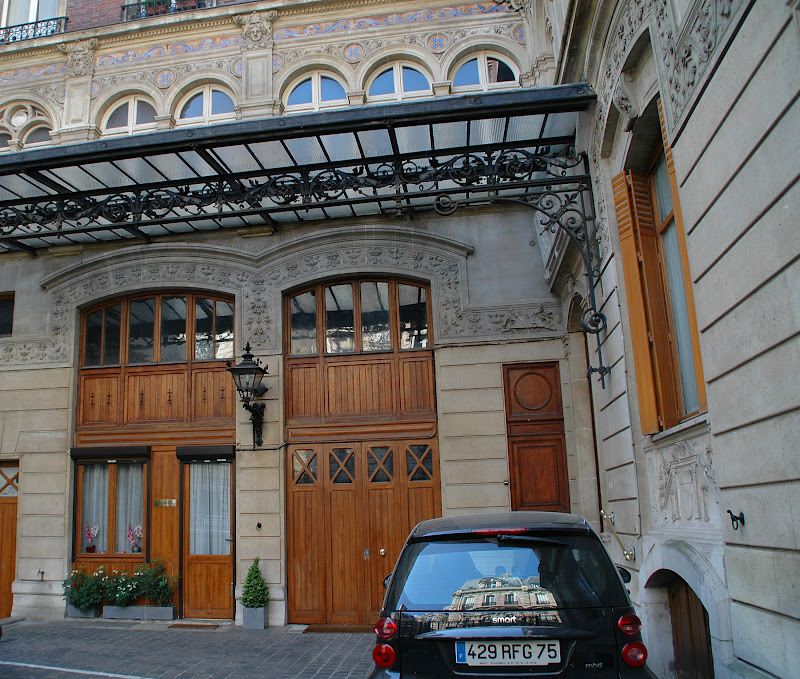
Is the awning by Hector Guimard?

That was my original question when I lifed my camera for a shot.  In the subsequent months I have found that the awning is but a part of this amazing residence designed in 1870 by the architect Gustave Clausse.  The rez-de-chaussée et le premier étage (ground floor and the next floor) were built in stone and the three upper floors in patterned brick.  Above the awning you can see the arched windows decorated with polychrome ceramics. 

So, is it a Guimard?  Honestly, I do not know.  Most of Guimard's Paris work was started about 10 years after this building was completed.  There are more secrets about this residence, and I will share a special one with you another time.


Residence
9, rue Murillo
75008, Paris

For more reflections go to James' Weekend Reflection

Wednesday, June 6, 2012

Hector Guimard - art nouveau


The graceful curves of this wrought iron and glass awning are typical of art nouveau detail.
The pattern on the stones resembling coral are called "vermiculation" as it mimics the trail of worms in soft soil.  This is one form of an architectural technique known as "rustication" which has been in use at least since the rennaissance period.  You may have noticed this same pattern on the Louvre palace and Haussmannian buildings around Paris.


This elegant home which sits inside the gates of Parc de Monceau has a stunning main entrance in the courtyard.  This is just the "back door."


5, ave Van Dyck
75008, Paris